
KISA NDIS Assistive Technology - NDIS Funded Personal Alarm and Safety Devices
KISA NDIS Registration Number is 96153614
KISA is an Australian manufacturer and provider of custom-made safety and communication solutions designed to benefit individuals with special needs.
Many people (including most NDIS participants) are well served by mobile phones and other communication tools. For others, tailored settings or software apps can give access to mainstream smart devices. For those with complex communication or cognitive disabilities, or who need braille to access their devices, KISA offers tailored solutions, KISA Companion and KISA Personal Alarm.
KISA safety and communication devices are neither mobile phones, as they don’t have a keypad to dial numbers, nor smart devices, as they don’t have a screen to display and view information, such as internet access.

While a wide range of individuals can benefit from KISA Devices and Services, it is especially transformative for those with the following disabilities:
- Physical Disabilities and Mobility Impairments: Individuals with conditions that affect their mobility and increase the risk of falls, such as spinal cord injuries, multiple sclerosis, cerebral palsy, and arthritis, derive immense benefit from these devices and services.
- Cognitive Disabilities: For individuals with cognitive disabilities such as dementia, Alzheimer's disease, or brain injuries, KISA Devices and Services offers an essential layer of safety.
- Sensory Disabilities: Individuals with hearing or visual impairments can face significant challenges in an emergency. KISA Devices and Services are a vital link between a person in an emergency, emergency services, carers and family members.
- Intellectual Disabilities and Developmental Disorders: For individuals with intellectual disabilities or conditions like Autism Spectrum Disorder, KISA Devices and Services can provide a sense of security and support independent living.
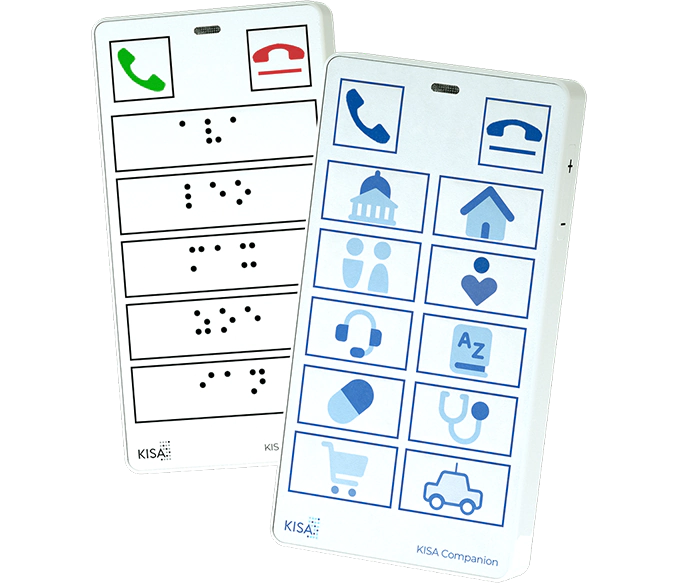
KISA’s Companion and Personal Alarm devices are unique solutions designed to help people with specific needs.
Some disabilities, including intellectual or physical, cause an inability to reach out for help using other non-KISA devices.
KISA Companion and KISA Personal Alarm are designed to allow immediate communication between the person with disability and the carer with a press of a single button, providing safety and security for the person with disability.
KISA services are designed to complement and
improve the safety and security of people using KISA
devices.
KISA GPS Tracking Service
Improved safety for KISA device users is achieved by quickly establishing their location if they are lost or need to reach out for help but cannot provide their current location. In an emergency, both the speed and accuracy of establishing the location are critical for the safety of the person using the KISA device. KISA devices are capable of live location monitoring that can be shared with multiple parties in case of an emergency.
KISA Reminders Service
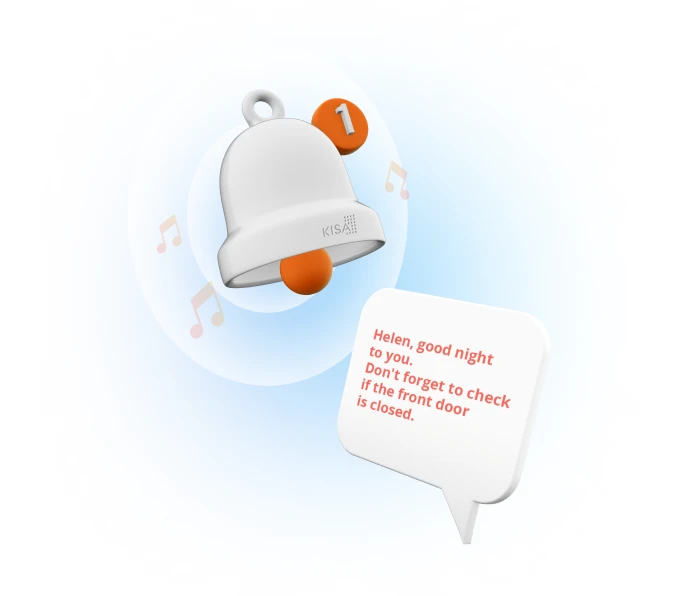
Certain physical and intellectual disabilities make it difficult or impossible to track time, manage tasks, and remember to complete them on time. The current solution for individuals unable to use mobile phones, smartphones, or other smart devices is to rely on carers and support teams to structure the day and remind them to complete tasks like taking medication or going to the bathroom. KISA Reminders Service offers a clear and timely way to remind a person about a scheduled task, while also ensuring privacy, dignity and safety. If a critical reminder is not answered, the appropriate person can be automatically notified, preventing a reduction in the safety and health condition of the person with disability.
KISA Shield Service
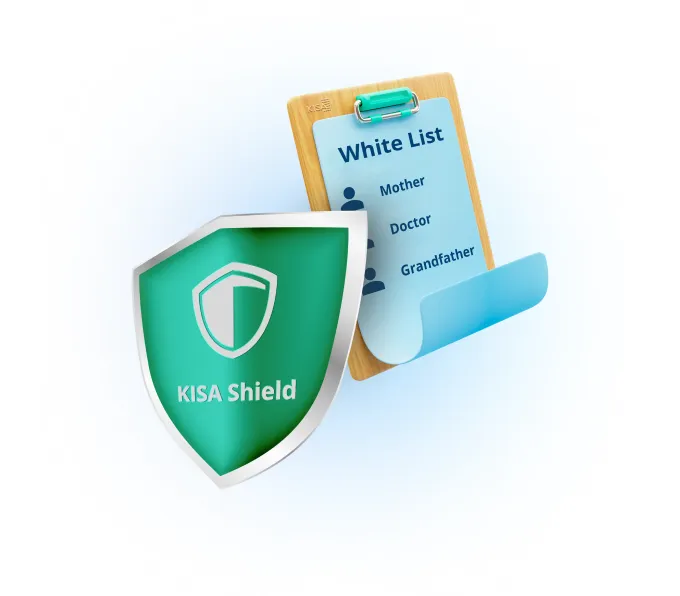
Since the KISA device is neither a phone nor a smart device, there is no way for the person using the KISA Companion or KISA Personal Alarm to identify the person contacting them using the KISA device. KISA Shield Service provides safety and security to the KISA Device user by protecting against unauthorised inbound contact, such as scams and harassment.
KISA 24/7 Monitoring Service
While a wide range of individuals can benefit from 24/7 monitoring, the service is especially transformative for those with more complex needs. The safety and security of individuals with disabilities are enhanced because the initial contact is with a trained 24/7 monitoring operator. This operator has all relevant information about the caller, such as location, other emergency contacts, and any critical information provided during the service setup.
KISA Fall Detection
For people with disabilities, falls are a serious and pervasive risk, often leading to injuries, loss of independence, and a decline in quality of life. Mobility, balance, and spatial awareness challenges make people with disabilities particularly vulnerable. Beyond physical injuries like fractures or head trauma, the fear of falling can trigger anxiety, reduced activity, and social isolation.
Fall detection technology provides a vital safety net, ensuring rapid response in emergencies and giving users greater confidence and independence. All KISA devices are equipped with fall detection sensors, automatically identifying falls and summoning help, even if the individual is unconscious or unable to call for assistance themselves.
KISA NDIS Companion Package is available under the following Support Budgets
Communication and Information Equipment
Assistive Products For Personal Care And Safety
Vision Equipment
My NDIS Funding is
Agency Managed
Plan Managed
Self-Managed
These devices are designed to help people who can not or should not be using modern mobile phones, like smartphones or simple phones
KISA Assistive Technology device and KISA Personal Alarms were developed with large, easy-to-read print, high contrast colours, a dedicated emergency services button, and customisable raised tactile buttons with optional rubber bumps.
KISA devices can also be manufactured with braille font on the buttons for easy recognition by people who can read braille. Each button is limited to a maximum of 7 braille characters.
KISA devices are also designed for people with a wide range of cognitive problems and brain disorders. They are so simple to use that getting in touch with your contacts is as simple as pressing one button.

Common Questions About NDIS Assistive Technology
Yes. KISA has been a registered NDIS provider since 2014 (Registration No. 96153614). KISA supplies assistive technology devices including the KISA Companion and KISA Personal Alarm, designed for NDIS participants with disability-related communication or safety needs.
KISA devices are funded under the Assistive Technology support category, specifically Communication and Information Equipment. Some services may also be funded under Core Supports, depending on the participant's plan and goals. Contact KISA or your support coordinator to confirm the right funding category for your plan.
Yes. The KISA Companion can be funded through your NDIS plan under the Assistive Technology budget. Contact KISA or your support coordinator to obtain a quote for your plan review. KISA can provide all documentation needed to support an AT funding request.
Low cost assistive technology refers to AT items priced under $1,500 that NDIS participants can purchase directly without a formal assessment. The KISA Companion falls within this category for many participants, making it accessible without lengthy approval processes.
The KISA Companion is designed to support goals across several NDIS outcome areas. For improved daily living, it enables reliable communication with trusted contacts without requiring the participant to navigate a smartphone. For increased social and community participation, it keeps participants connected to family and support workers in a way that suits their abilities. For independence and choice, it gives participants a safe way to initiate contact and call for help without relying on a carer to be physically present. For safety, GPS tracking and automatic fall detection support participants in a range of settings. A support coordinator or KISA team member can help match the device to specific plan goals.